

Electricity is the lifeblood of every modern enterprise, yet for most commercial and industrial (C&I) customers the utility bill is a stubborn combination of rising energy rates, volatile demand charges, and mounting carbon-reduction pressure from investors, regulators, and supply-chain partners.
Enter the commercial energy-storage system (ESS): a container-size, lithium-battery-based asset that charges when power is cheap or green and discharges when power is expensive or scarce. ESS turns a passive meter into an active, money-saving, carbon-cutting resource. Global C&I storage deployments were worth roughly US $15 billion in 2023 and are forecast to triple by 2032 as more businesses realize the financial, operational, and sustainability advantages of on-site batteries.
This article explains how commercial ESS works, where its savings come from, how it fits into corporate decarbonization plans, and what to consider before investing.

What Counts as a Commercial ESS?
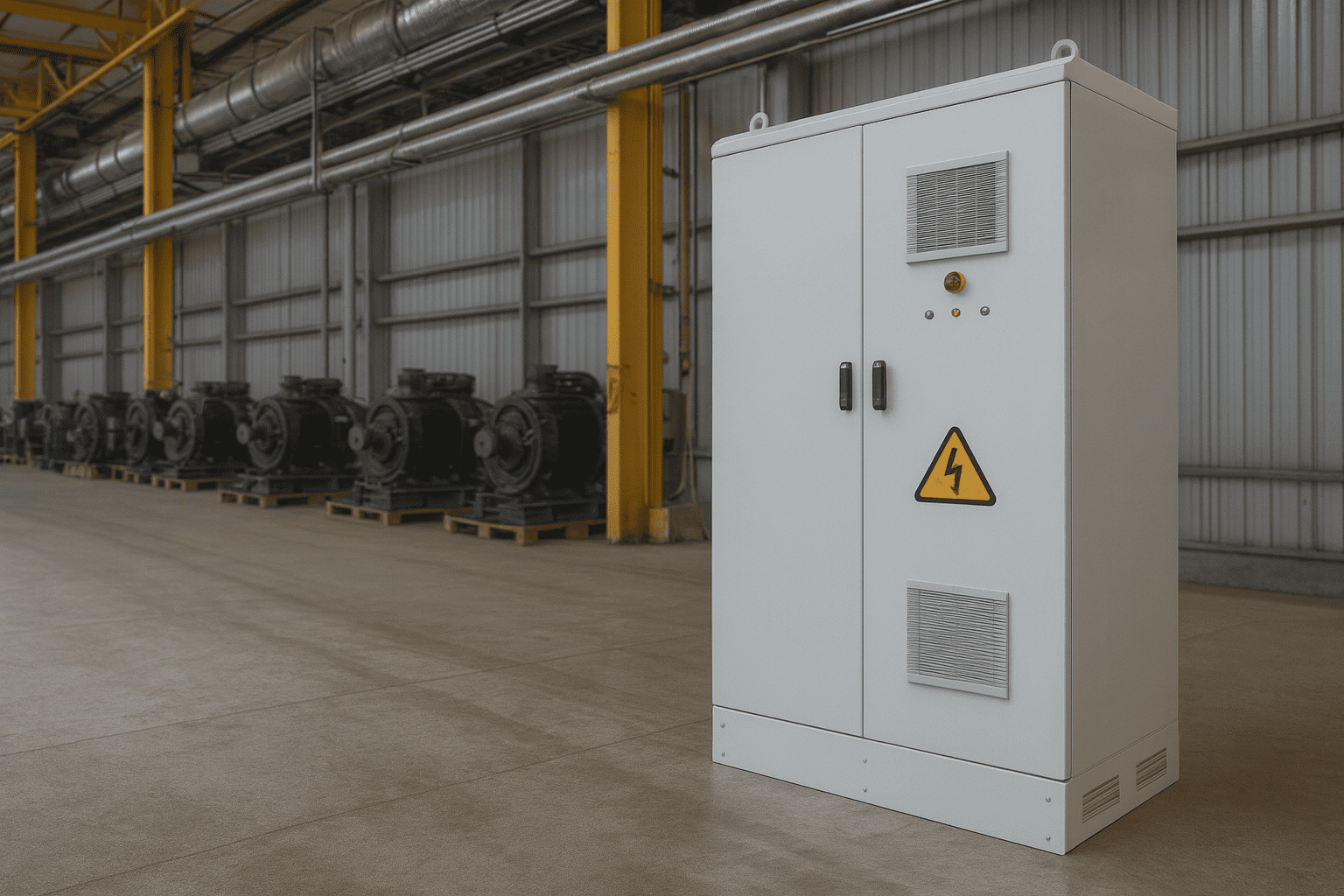
A commercial ESS is typically a 50 kW to 5 MW inverter plus 100 kWh to multiple MWh of lithium-ion batteries installed behind the customer’s utility meter. Packaged in rack-format cabinets or ISO shipping containers, today’s systems feature:
● Lithium-iron-phosphate (LFP) cells for long cycle life and superior fire safety.
● Battery Management Systems (BMS) that protect each cell from over-temperature, over-current, or over-voltage events.
● Power-conversion systems (PCS) that invert DC to AC (and vice-versa) and react in < 50 ms, fast enough for grid-support services.
● Energy-management software (EMS) that forecasts load, solar output, prices, and carbon factors hour-by-hour.
A well-designed ESS operates silently, requires minimal routine maintenance, and integrates with rooftop or ground-mount solar, emergency generators, or microgrid controllers.
Economic Drivers: Demand Charges & Volatile Tariffs
Peak-Demand Penalties
In many electricity tariffs, demand charges account for 30 %–70 % of a commercial bill because the utility must size wires, transformers, and generation for the customer’s single highest fifteen-minute peak each month. An ESS attacks that peak by discharging during the critical window, trimming demand and slashing the penalty.
Time-of-Use Spreads
Wholesale power prices can jump ten-fold between mid-day oversupply and early-evening scarcity. Batteries arbitrage that spread—charging when prices dip, discharging when they spike—saving money even in markets without explicit demand charges.
Outage Avoidance & Resilience Value
A one-hour blackout can halt a semiconductor fab, spoil a cold-storage warehouse, or force a hospital onto expensive diesel. Quantifying avoided downtime often makes the business case for ESS even before energy savings are counted.
Technical Benefits Beyond the Bill
● Peak Shaving: Smooths a facility’s load curve, reducing transformer stress and HVAC chiller cycling.
● Load Shifting: Stores on-site solar at noon for evening use, raising self-consumption to 80 % or more.
● Power-Quality Support: Inverters deliver reactive power and fast frequency response, improving equipment life.
● Backup Power: Provides seamless UPS-grade switchover for critical circuits during grid faults.
● Grid Services Revenue: In some markets ESS owners earn extra income by enrolling in frequency regulation or demand-response programs.
A case study from a San Diego sign manufacturer shows a 60 % monthly demand-charge reduction after installing a battery system that shaved 97 kW of peak load.
Cutting Carbon: ESS as a Decarbonization Catalyst
Maximizing On-Site Renewables
Solar panels deliver carbon-free power, but only when the sun shines. Pairing PV with ESS lets businesses shift daytime generation to evening operations, raising the percentage of self-supplied green energy and reducing Scope 2 emissions.
Enabling Diesel-Off Microgrids
Mining camps, island resorts, and remote telecom towers can curtail diesel gensets by 40 %–60 % when a battery absorbs solar over-generation and releases it after sunset, translating into hundreds of tonnes of CO₂ savings per year.
Corporate ESG & Supply-Chain Credibility
Customers and investors increasingly ask suppliers to publish greenhouse-gas metrics. ESS helps companies demonstrate concrete action toward science-based targets, strengthening bids and investor confidence.
Battery Technology & Safety Fundamentals
|
Attribute |
LFP Cells |
Nickel-Rich NMC Cells |
Flow Batteries* |
|
Cycle Life (@ 80 % DoD) |
6 000+ |
3 000–5 000 |
10 000+ |
|
Thermal Runaway Threshold |
≈ 260 °C |
≈ 180 °C |
Non-flammable |
|
Energy Density |
Moderate |
High |
Low |
|
Cap-Ex $/kWh (2025) |
$$ |
$$$ |
$$$$ |
*Flow batteries excel at 4- to 10-hour discharge durations but are still niche in C&I scale.
Most commercial systems choose LFP for its balance of cost, life, and safety. Modern units add multi-layer fire containment, gas sensors, and automatic isolation to meet UL 9540A and IEC 62933 safety standards.
Financial Models & Return on Investment
Cap-Ex & Op-Ex
Turn-key systems range from US $400 to $700 per kWh installed (2025 figures), depending on capacity, duration, and interconnection complexity. Operating costs are modest—mainly HVAC for the container and periodic inverter filter replacements.
Revenue & Savings Streams
1. Demand-Charge Reduction
2. Time-of-Use Arbitrage
3. Backup Avoidance (shadow cost of outages)
4. Ancillary-Service Payments (frequency response, spinning reserve)
5. Incentives & Tax Credits—for example, the U.S. Investment Tax Credit now covers standalone storage.
A National Renewable Energy Laboratory meta-study found that combining PV with storage reduced annual demand charges in more than 80 % of simulated C&I buildings.
Typical Payback
● Stand-alone peak-shaving in high-demand-charge regions: 3 – 5 years.
● Solar + storage with ITC or feed-in tariffs: 4 – 6 years.
● Resilience-driven installs (data centers, pharma): ROI calculated as avoided downtime rather than strict payback, often justified immediately.
Deployment Considerations
1. Load Analysis: 15-minute or 1-minute interval data sets a baseline for battery sizing.
2. Interconnection Rules: Some utilities cap export, require relay protection, or mandate UL 1741-SA smart-inverter functions.
3. Space & Weight: A 1 MWh LFP container weighs ~25 t and needs reinforced concrete plus HVAC clearance.
4. Fire Codes: NFPA 855 in the U.S. and IEC 62933 globally specify setback distances and ventilation.
5. Scalability: Modular cabinets let operators add capacity as tariffs change, EV fleets grow, or solar arrays expand.
Sector Snapshots & Case Studies
Food & Cold-Chain Warehousing
Refrigeration drives sharp kW spikes when compressors start. A 430 kWh / 250 kW ESS in Kuala Lumpur cut a supermarket’s peak by 120 kW, saving US $6 800 per month and cutting 1 100 t of CO₂ annually.
Manufacturing & Heavy Industry
Metal-forming presses and plastic injection moulders draw megawatt-level pulses. Batteries smooth in-rush current, allowing smaller transformers and deferred utility upgrades.
Office Campuses & Hospitals
Maintaining power quality protects sensitive electronics and MRI equipment. During a recent West-Coast wildfire blackout, a hospital microgrid kept critical loads running for eight hours without diesel by cycling a 3 MWh ESS and rooftop solar.
Retail & EV Charging Hubs
A big-box retailer installed a 2 MWh battery plus 1 MW solar canopy. The ESS now supplies up to 70 % of the energy for thirty 150 kW EV chargers, keeping site demand under the utility’s punitive 500 kW limit.
Data Centers & IT Loads
Lithium storage is displacing flywheels and lead-acid strings because it delivers both uninterruptible power and grid services revenue during normal operation—essentially turning a liability into an asset.
Future Trends
● Longer-Duration Chemistries: Sodium-ion and iron-air aim for 8–24-hour discharge windows, unlocking round-the-clock renewable power.
● Thermal & Ice Storage: Pairing batteries with ice-making chillers lowers HVAC peaks, already saving megawatts in U.S. commercial buildings.
● Virtual Power Plants (VPPs): Aggregated C&I systems will bid into energy and capacity markets, following California’s utility-scale battery playbook that now supplies up to 20 % of evening peak on some days.
● Energy-as-a-Service Contracts: Third-party ownership models let businesses deploy ESS with zero cap-ex, paying via shared savings.
Conclusion
Commercial energy-storage systems transform electricity from a fixed cost into a strategic asset, trimming demand charges, unlocking rooftop solar value, protecting operations, and accelerating the race to net-zero emissions. Whether you manage a factory, a logistics hub, or a nationwide retail chain, the numbers—and the climate imperative—now favor batteries.
Ready to see how an ESS could slash your energy costs and carbon footprint? Contact JazzPower for a no-obligation feasibility assessment and customized savings forecast.